Page contents

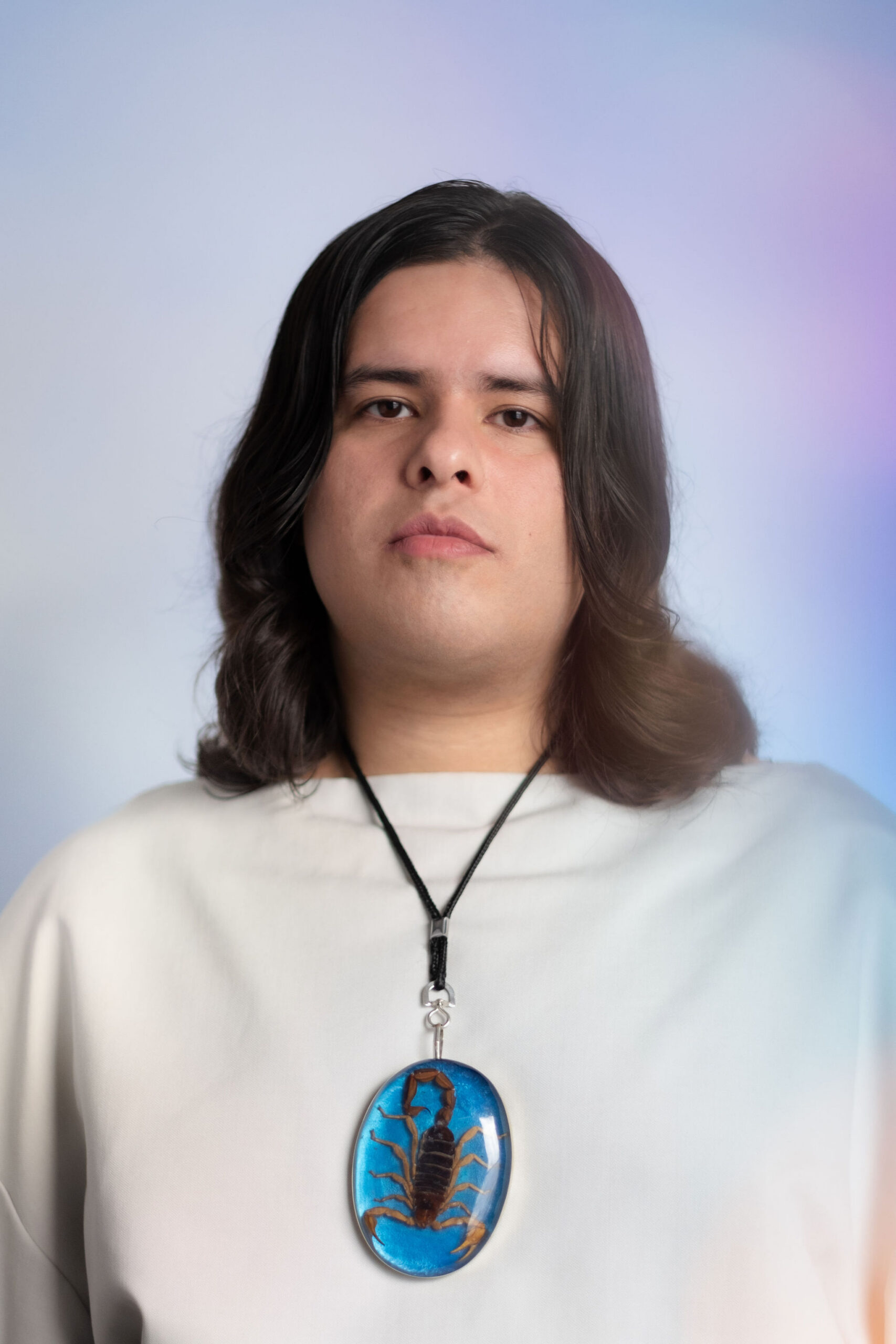
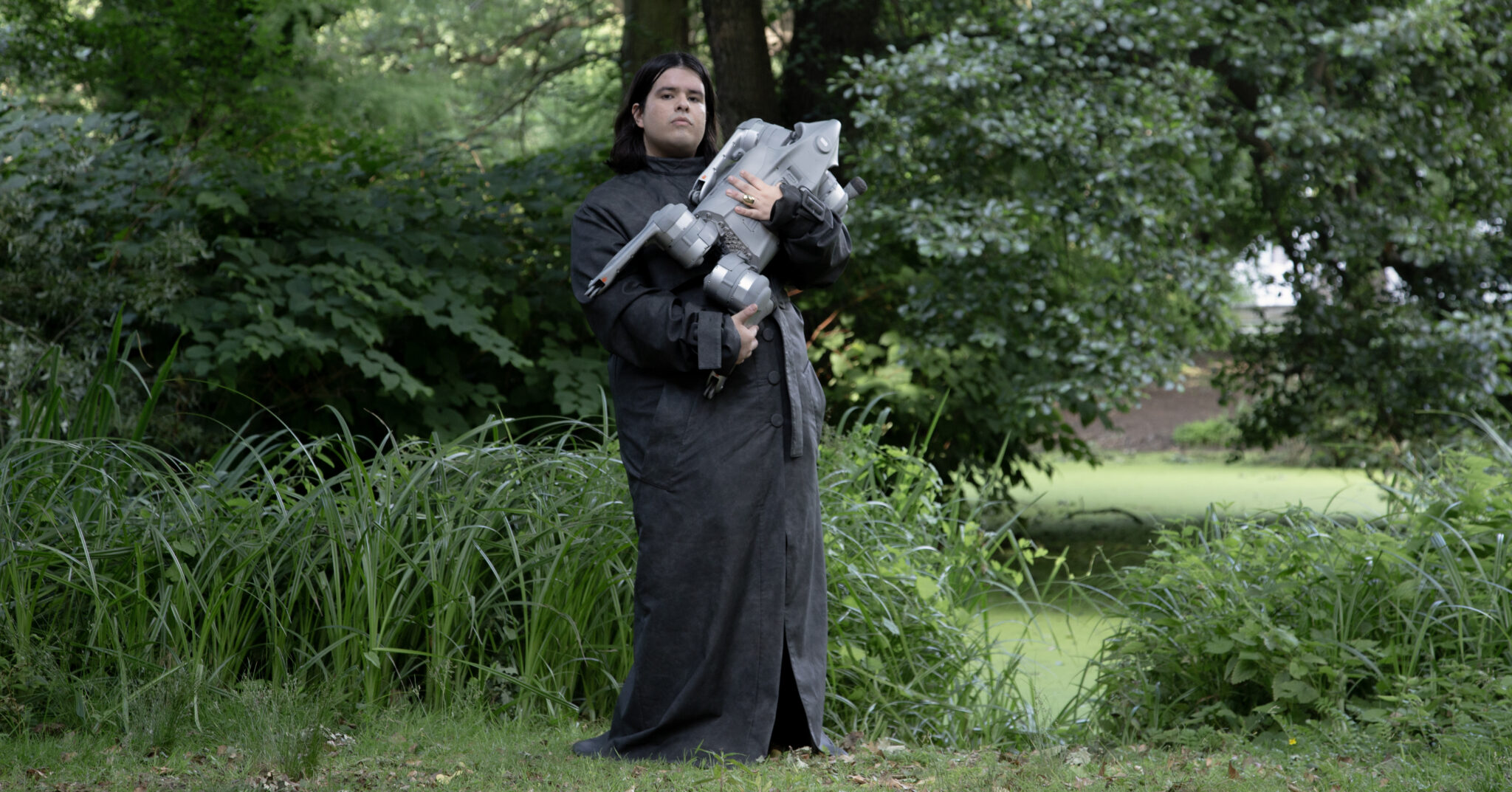
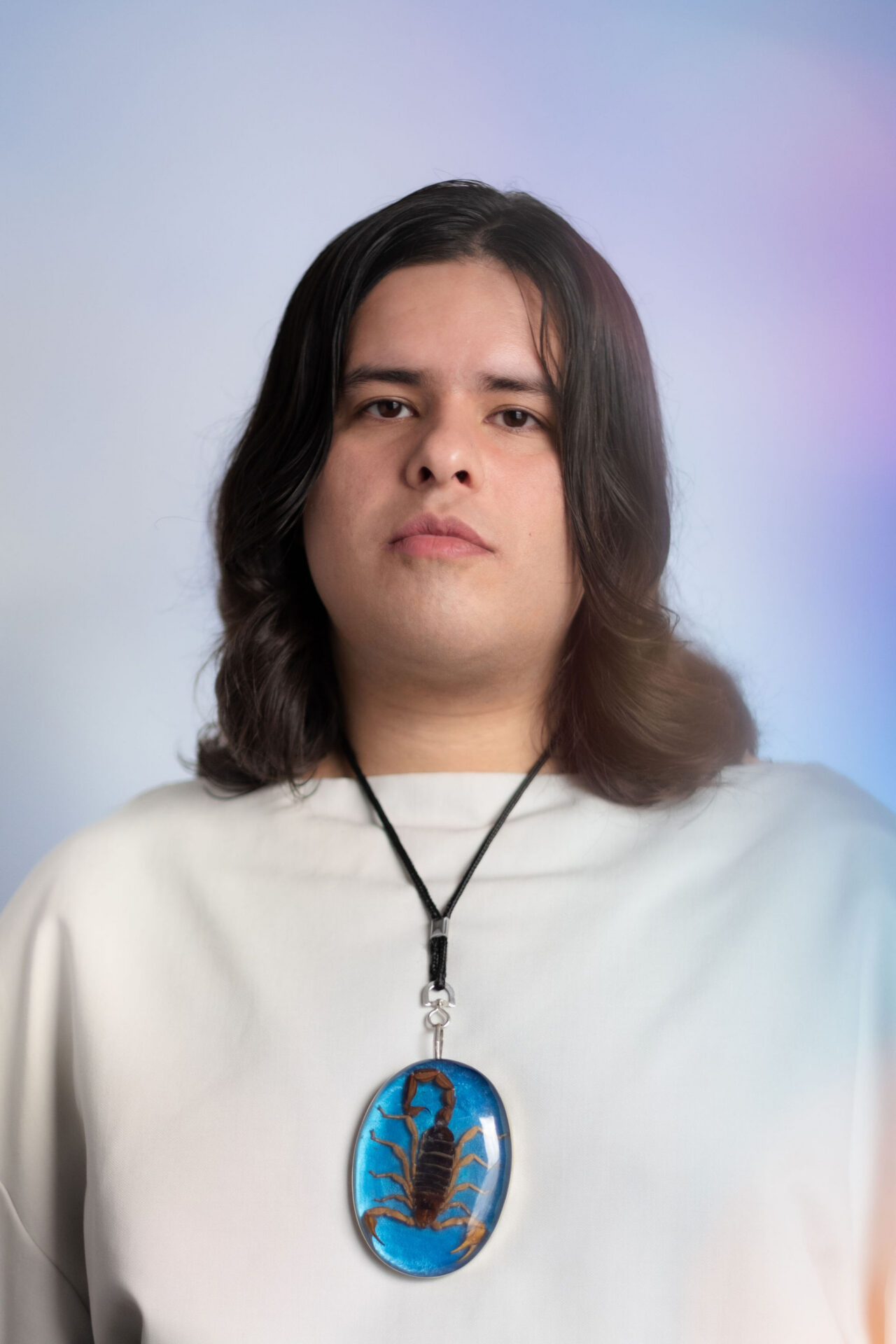
Portrait of Eyebeam Speculating on Plurality Resident 2026, Kira Xonorika. Image Credit: Chanel Matsunami / Gidra Studios.

With Kira Xonorika
Pronouns
They/them
Date and place of birth
b. 1995, Asunción, Paraguay
Current location
New York
Year(s) of residency and/or fellowship
2026, Speculating on Plurality Resident

Special to Feed


Artist Bio

Kira Xonorika is an interdisciplinary artist and author working across generative AI, film, robotics, sculpture, performance, and text. Xonorika’s work explores the connections between technoscience, interspecies and planetary intelligence, worldbuilding, Indigenous sovereignty, and ecology. They have received awards, residencies, and fellowships from the Vera List Center, Akademie der Künste, Dreaming Beyond AI, Hyundai Artlab, the Max Ernst Museum, and Ars Electronica. In 2024, she spearheaded Future Memory Lab, South America’s first GenAI art residency, with support from the Swiss Arts Council. Kira’s work is in the collection of the Denver Art Museum, marking the first artwork in the museum’s collection to incorporate generative AI technology.

Tell us about yourself.

KX: I am an interdisciplinary artist and author of Guaraní descent, currently working between Lenapehoking and Tovaangar. I work across different media, including film, robotics, sculpture, performance, text, and generative AI. I am particularly interested in the connections among technoscience, interspecies and planetary intelligence, Indigenous sovereignty, and ecology. Basically, my work reframes human interaction with technology and various scientific methodologies through the lens of Indigenous futurisms*, where I simultaneously look to the past to move forward into the future, affirming life-centered design futures. I also think a lot about unseen realms and occult practices, magic, witchcraft, and forms of conjuring worlds. I draw much of this from the Indigenous traditions of the Guaraní peoples.

*Note for readers: Dr. Grace L. Dillon coined the term Indigenous futurisms in 2003. It is a movement in media that reflects Indigenous ways of knowing and oral histories, envisioning alternative futures that reclaim agency and re-imagine relationships with land, technology, and spirituality. Dillon outlines how science fiction can aid in the process of decolonization, organizing alternative narrative techniques such as First Contact (apocalypse), Returning to Ourselves (reclamation), Native Slipstream, “infus[ing] stories with time travel, alternate realities and multiverses, and alternative histories,” allowing narratives to explore “time as pasts, presents, and futures that flow together like currents in a navigable stream” and that offer “nonlinear thinking about space-time.”

Xonorika, K. (2021). Post-generalist Fantasies / Temporalities of Latin American Trans Arte-flux Journal, Issue #117, https://www.e-flux.com/journal/117/387456/post-genitalist-fantasies-temporalities-of-latin-american-trans-art.

I read some of your early work, and I found it interesting to see the image of the monster invoked in relation to transness. Tell us a bit about the piece.

KX: In 2021, I was commissioned by McKenzie Wark to write a piece for the e-flux Journal on post-genitalist* fantasies and temporalities* in Latin American art. I specifically wanted to examine the ideas around monsters, which in literature, movies, and popular media are commonly seen as humanity’s antagonistic opposite, as pathological entities embodying Otherness. And with the necropolitical* landscape of Paraguayan politics (really, the entirety of the world), experiencing the rise of regressive gender policies, I wanted to speak about the monstrification of queerness that national institutions manufactured to block reforms that allowed access to necessary material conditions for survival: community, education, food, healthcare, and housing. But also on a cultural level, online through memes, where trans women like Maritza undergo the trauma of mass-media exposure, reduced to object-fetish, to be mocked, whose live television interview was edited to produce an exaggerated comedic effect.

*Note to readers: post-genitalist fantasy is the exploration of gender outside of essentialism and binaries, beyond anatomical reductionism that can be prevalent in discussions around queerness and transness. This theory emerges from Queer and Trans Latin American avant-garde discourse, proposing a critical framework that detaches community, identity, and desire from traditional thought systems centered on anatomical structures.

Temporality refers to the multiple, subjective ways in which time is experienced, structured, or perceived, often in contrast to the linear, clock-based time evoked by Western constructs of time. https://www.dukeupress.edu/beyond-settler-time 

Necropolitics is a sociopolitical theory that examines how social and political power dictate how some people may live and how some must die. The deployment of necropolitics creates what Achille Mbembe calls deathworlds. Mbembe identifies racism as a prime driver of necropolitics, stating that racialized people’s lives are systemically cheapened and habituated to loss.

Considering that Paraguay, where I am from, is seen as the laboratory for the advances of anti-gender politics, the idea of the monster as an analogy to transness felt palpable. In a colonial cis-tem (system), the trans body is framed as nonhuman, as the abject, the monstrous, the hypersexual, and the laughable.

In this, I discuss how the process of monstrification is not a novel experience in Latin America, given the historical context of European colonization of Abya Yala,* in which the Spanish and Portuguese stripped lands of material resources, fueling the development of capitalism and the Transatlantic Slave Trade. There was also a dispossession of the many living forms of knowledge, languages, spiritual practices, culture, and an “epistemicide,” a genocidal process that erased memories, perceptions, intuitions, and traces.* 

*Abya Yala: In the Guna language, it means ‘land in its full maturity’ or ‘land of lifeblood,’ a pre-Colombian term used in search of building a sense of unity and belonging amongst cultures which have a shared cosmovision (for instance, a deep relationship with the land) and a history of colonialism.

*Fran Demétrio e Hilian Nissior Besuan, “O conhecimento dos outros, a defesa dos direitos humanos epistémicos,” Diálogos Regionais e Internacionais Multi Inter e Transdisciplinares 5, n. 1 (2019): 111.

Generally speaking, I am interested in exploring the connections between Alien and Monsters to Queer and Trans semiotics. I see Aliens and Monsters as different manifestations of the Other. They both represent that which is beyond human, the extra-human. Both have some form of abjection, monsters more traditionally so. What I am interested in is the aspect of aliens: that there’s an outer layer of intelligence, and there’s this assumption that they come with a purpose.

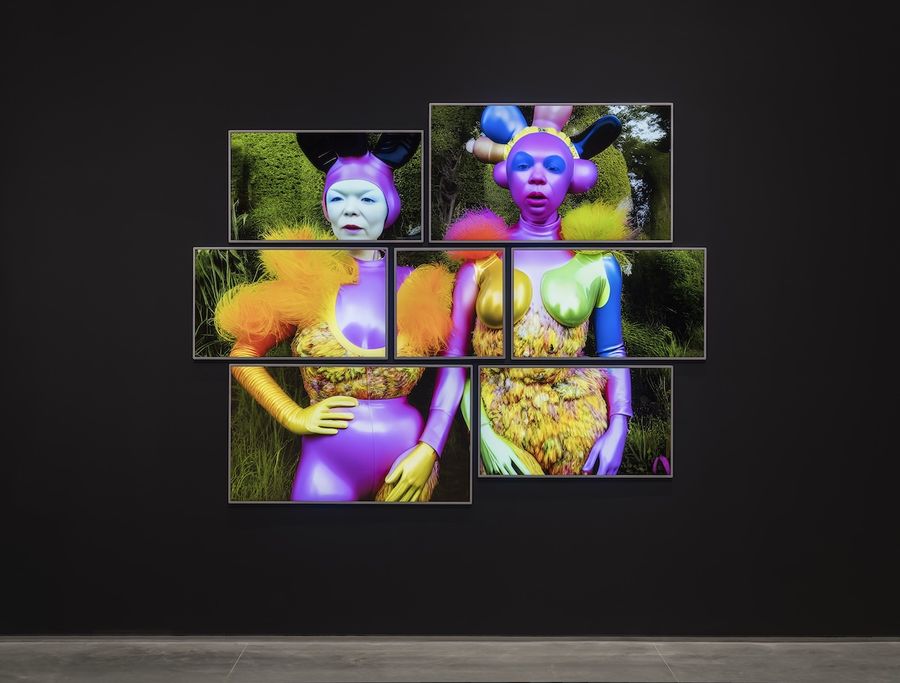
Installation View, Kira Xonorika, ‘Teleport us to Mars,’ 2022. The Ford Foundation Gallery. Photo Credit: Sebastian Bach.

Your journey exploring AI as a tool is interesting. How did you start, and what prompted you to explore it?

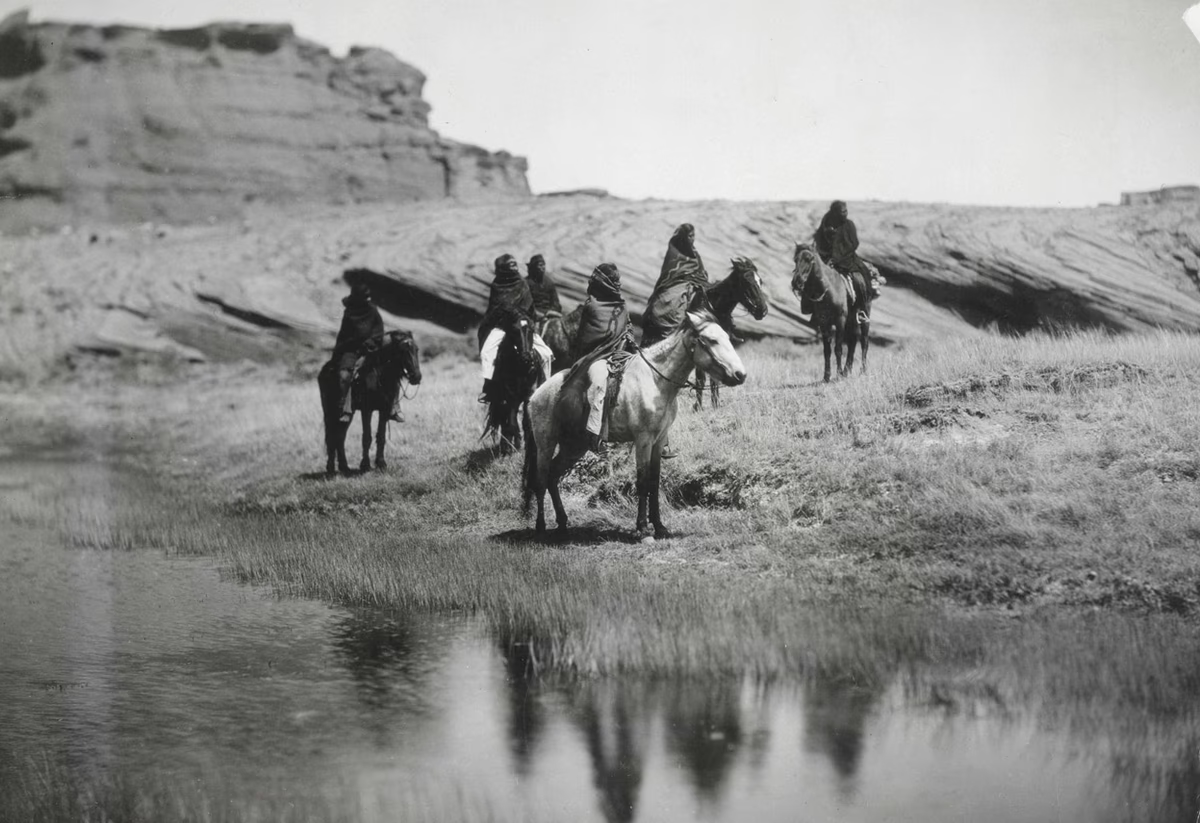
KX: I was in LA, and it was so hot outside. I couldn’t go on a hike, but I really wanted to. Instead, to avoid the heat, I asked myself: What if I tried this AI-generative thing everyone is talking about? That process was playful. As a writer, I focused on trying out different terms, synonyms, branches, and all, and seeing how those semantic variations influence what was generated. When I prompted the term “Indigenous” in various forms, trying to push the boundaries of representation, it would mainly spit out incredibly stereotypical outputs that were a pastiche of different North American Native American cultures, e.g., ceremonial headdresses and war bonnets worn by warriors of the Great Plains tribes, Oceti Sakowin (the Sioux), or the Niitsitapi of the Blackfeet Nation. Even very limited representations of the phenotypes most people associate with Indigenous people, along with a lot of anthropological imagery, like the ones that emerged from the era of colonial expeditions across the Americas in the 1800s. A time when the development of travel camera technology was instrumental in manufacturing evidence of racial hierarchies/taxonomies, promoting imperial justification for domination and subjugation. Most of what was generated came from this dataset, hosted by large corporate language models and AI Chatbots like Stable Diffusion. 

Out of this time in playing with the app and avoiding the heat, important questions emerged, ones that I often work through in my practice today: Who are the people who control the databases, and how do they decide what information gets fed to the model? How is access to decision-making determined?

As a writer, how are you noticing how language is being resourced in this system? If it’s spitting back stereotypes, there must be significant limitations in the datasets. How are you working with these limitations?

KX: I tend to think a lot about language in relation to generative AI since it relies heavily on majoritized languages, and, as a result, there are specific ways to prompt an AI “properly.” There is a semantic bias toward English, and the next languages with sufficient data to prompt crisp detail are Mandarin, Arabic, Spanish, or French; after that, the less prioritized group includes Korean, Russian, and Portuguese. But no Indigenous [not referring to national] languages. Basically, these are considered “low-resource” languages; over 90% of the world’s 7,170 living languages. Indigenous languages are marginalized by AI language model systems because there is insufficient digital text and structured datasets, which also speaks to the state of archival materials for these languages, the critical loss of languages subjected to linguicide, and the lack of resources to preserve them through education and community models. 

As a writer, language is important to me. Languages are houses we build, and words are containers for knowledge; they have the capacity to communicate it. And, they are also spells, encapsulating both the material and the immaterial worlds. In different languages, language can activate opaque practices, such as magic, that embody the unseen and the metaphysical. Language can be activated in so many different ways, depending on how these “houses” were formed. 

I really like to reimagine these binaries and the spaces beyond them, the imaginaries they create, and hope to get everyone to reorient their attention to how we can see the beauty beyond these rigid ways of being. 

Six Navajo on horseback, taken circa 1904. Library of Congress/Edward S. Curtis.

Prompting in a different language led to more precarious imagery results. Mashinka Firunts Hakopian [2024 Democracy Machine Fellow] discusses this in her essay, “Algolinguicism: Translating Language Justice to Digital Platforms. There’s a system of processes that discriminates against and obstructs meaningful participation by minoritized language-users outside the Global North. If biases and discrimination are present in this data set as well, certain image genealogies are either absent or presented in ways that do not affirm realities, because there’s obviously an acculturation dimension that comes with language and with who gets to program these tools. And because of this, I have to become anti-disciplinarian in how I use and blend languages, mixing English, Spanish, and Guarani to generate meaningful, life-affirming imagery. There’s a lot of experimentation with language forms and language mixing. 

English and Spanish are colonial languages. But another layer to this is that even the Guarani language has been manipulated through colonization. We see this with several words, one of them “jopói,” which originally meant “What is mine is yours,” accompanied by a gesture of giving; there is an innate reciprocity in this that does not include one-way transactional giving. But in the contemporary context, this work is related to “gift,” a one-sided exchange related to dispossession. The term originally also is a protocol for preserving opacity and honoring relationships with human and nonhuman kin—AI or alternate intelligence. 

I am using this approach not only to reinterpret but also to examine these language transitions in Guaraní.

In this exploration, world-building and language come into play. To quote Jota Mombaça, Brazilian writer and visual artist: “Any world project, formally articulated in a colonial situation, is subject to the same destiny of the pre-colonial worlds.” So we must reorient. As a person who is future-forward, not wanting to repeat the patterns of the past, defying the necro-political tendencies of colonial structures, in which de-futuring has been the narrative norm surrounding indigeneity and queerness—I always want to build on beauty, expansiveness, and, most importantly, presence.  

AI As Ancestral Intuition, Your Art Is A Spell, Season 1 Episode 3.

Edgar Fabián Frías in conversation with Kira Xonorika

AI reflects what we give it: an eating machine and a mirror. What is something you’re noticing about how language is being used to generate output?

KX: Back in 2022-2023, I noticed that many people working with AI often use it to generate images of Dystopia. And today, in art made in the Western world, I see a lot of thematics around cataclysm, the end of the world, and artists probing what can emerge from a world that ended.   

What we see in Western languages is that such systems gravitate towards defining permanent, unchanging states and binaries: between the human and the non-human; the savage and the civilized; the natural and the artificial. Alien versus terrestrial. Monsters versus angels. Western languages reinforce colonial projects. In the tradition of Science Fiction, in the Western world, we often see the binary orientations of Utopia versus Dystopia; Techno-optimism vs Techno-doomerism. There’s this binaristic way of thinking: what is dystopian for a few may be a utopia for many, and vice versa. 

I think a lot about the words of Protopian futurist thinker Monica Bielsky, who talks about a future as a place that we build together, that requires us to co-create. This process isn’t binary or Black-and-White; it requires interdependence and plurality of knowledge and thought, which are enmeshed in science and creativity. A dialogical process that requires collective prototyping, addresses real issues, and does not escape the world.  

I look at ancestral futures as a potential for worlding, and for that to happen, there must be conditions for rebuilding the world, not looking to revive pre-colonial worlds, but to follow alongside the ancestral. For decolonization, there needs to be a decomposition of systems and the dismantling of barriers. Still, as we know from the land and its cycles, we can’t exist only in decomposition. There needs to be a process of regeneration, of reblooming, that includes the redistribution of resources and a commitment to long-term structural rebuilding that incorporates reciprocal partnerships, protocols of accountability, and justice-oriented methodologies. 

You have written a few essays about plural Indigenous futures for the Artlab Editorial and Momus Critical Writing Fellowships in 2023-2024. I really love how you frame speculative fiction and language as a means to re-future, drawing on connections to various Indigenous cultures and languages as a conduit. 

KX: Indigenous thinking has always been a focal point of my practice. Back in 2024, for the Artlab Editorial Fellowship with Hyundai Artlab, I wrote about the constellation of Indigenous artists who use technology to materialize indigenous futures and language to embed a futurist foresight, moving forward while navigating through colonial histories. Basically, Indigenous futurism acts as a memory project, a somatic revitalization of a return to the woods as a space for communing, not necessarily restoring the pre-colonial world but to a way of “being.” 

Since migrating to the United States, that ethic has continued to shape my artistic research practice, which increasingly centers Indigenous and non-Western sovereignty in AI. In 2024, I co-founded Future Memory Lab, the first artist residency focused on generative AI in South America, to support artists working at the intersection of craft and emerging technologies.

My research, writing, and artwork draw on grassroots mobilization, speculative imagination, and Indigenous futurisms.

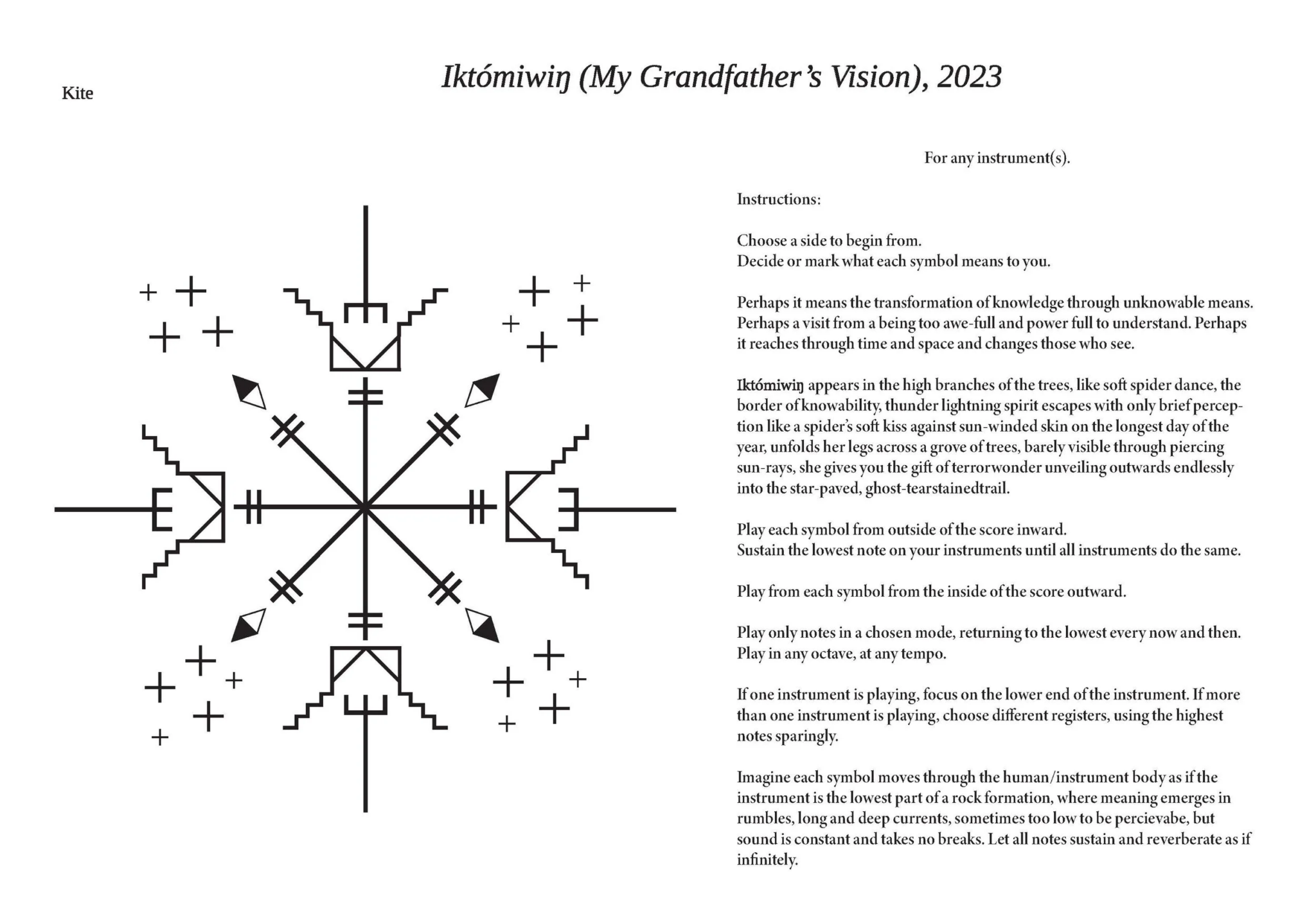
Kite, ‘Iktómiwiŋ (A Vision of Standing Cloud),’ 2023.

In a talk you gave at Future Days 2025, you shared a beautiful quote from Dr. Kite’s grandfather, Standing Cloud (Bill Stover), who speaks about the interiors of rocks through a Lakota lens/ontology*. I thought it was apt in illustrating a point about Indigeneity reframing how we think of technology:

“Stones are considered ancestors, stones actively speak, stones speak through and to humans, stones see and know. Most importantly, stones want to help. The agency of stones connects directly to the question of AI, as AI is formed not only from code but from materials of the earth. To remove the concept of AI from its materiality is to sever this connection; forming a relationship to AI, we form a relationship to the mines and the stones.”

KX: Indigenous ways of thinking around AI have been important to my practice. If you think about the mineral computation of AI in our technological devices, the silicon and Quartz microchips, copper wire, lithium batteries, Tungsten for vibrating features, everything is made of a certain form of materiality. AI isn’t a holographic or disembodied entity; it has a material reality and is connected to complex processes of extraction happening across the Global South, from the Congo, Bolivia, Chile, and Peru to Indonesia, across lands that were stolen from peoples who stewarded them. 

How do you see your work with Indigenous futurisms existing within the proliferation of pushback around the use of AI in art?

KX: My people were stripped of everything. I see using data to recover a certain form of rhythm as reparations. But I recognize that there is something real happening with ecological erosion and, through large data center colonialism, Big Tech needs to take accountability for this.

For my practice, I run my models locally and use a hybrid process. I work with a company that is limiting its data-ecological footprint. AI helped me recover some form of symbolic memory, which to me is incredibly valuable. And that’s a collaborative worlding tool alongside Indigenous artists across Abya Yala and the entire world. As a Xenofeminist, I embrace technology. There are also ideas about Indigenous artists being viewed in a very specific way, particularly in relation to craft, being looped into specific traditional handcrafts. Still, many Indigenous artists are unearthing Indigenous futurity through various emerging technologies, like the metaverse and AI, because these systems are suitable containers for questions about ecology, presence, connection, beyond-human intelligences, and power.

My work explores the re-Indigenization of intelligence through multimedia works, drawing on Guaraní cosmology and shaped by my experiences of migration and displacement. I approach technology not as a neutral tool but as a contested terrain where epistemologies [different kinds of knowledge systems] collide, and futures are negotiated. I am interested in how technoscience might be reoriented toward ancestral intuition, biosphere regeneration, and plural understandings of intelligence beyond Western hierarchies.

In the creation of speculative environments where nonhuman, ancestral, and machinic agents co-exist in film, robotic performances, and installations, I interrogate the colonial legacies embedded in data, language, and systems of representation. By engaging AI as both a medium and a subject, I seek to examine its capacity to reproduce dominant ideologies while also opening space for pluriversal imaginaries grounded in cosmological abundance. I like to explore this contradiction and see how something can emerge from that space.  

My practice draws from Indigenous and technofeminist epistemologies, cosmotechnics, and a view that calls for technodiversity, pushing for a pluralistic, anti-universalist view of technology that addresses humanity’s ecological and social problems. This framework calls for technology to be in dialogue with decolonial practices. I also call back to the process of re-memory, in which a “past that retains physicality also maintains a material influence in the present.” I work to rethink relations among land, body, and computation. Rather than treating intelligence as disembodied, abstract calculations, I am interested in its palpably lived, ceremonial, ecological, and relational dimensions, as expressed through its connection to human languages. 

Ultimately, my goal is to expand the ways intelligence is understood and practiced that are more just, regenerative, and plural. In developing methodologies that bring machine learning into relation with embodied knowledge systems. Through this, I explore how AI might encode reciprocity, relationality, and care rather than extraction and optimization. I hope to contribute to emerging artistic and critical frameworks that challenge monocultural planetary futures and make room for many coexisting forms of life, knowledge, and technological becoming.

Tell us the story behind Deep Time Dance.

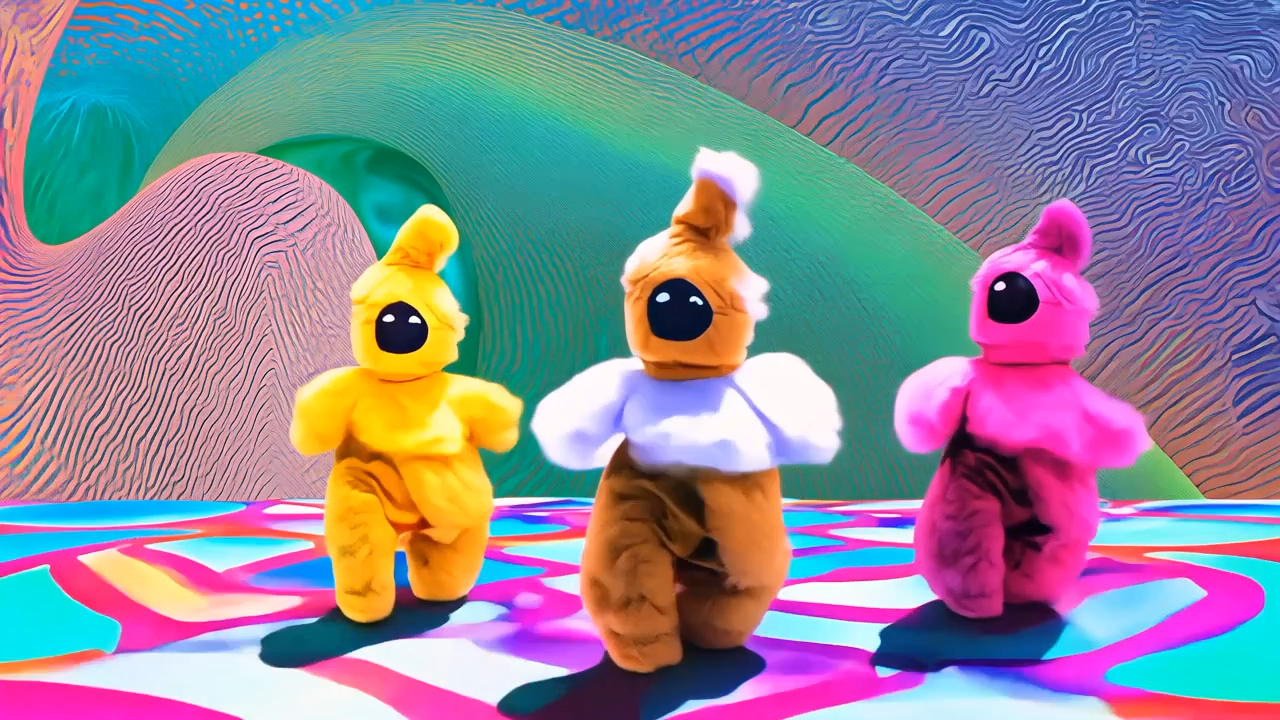
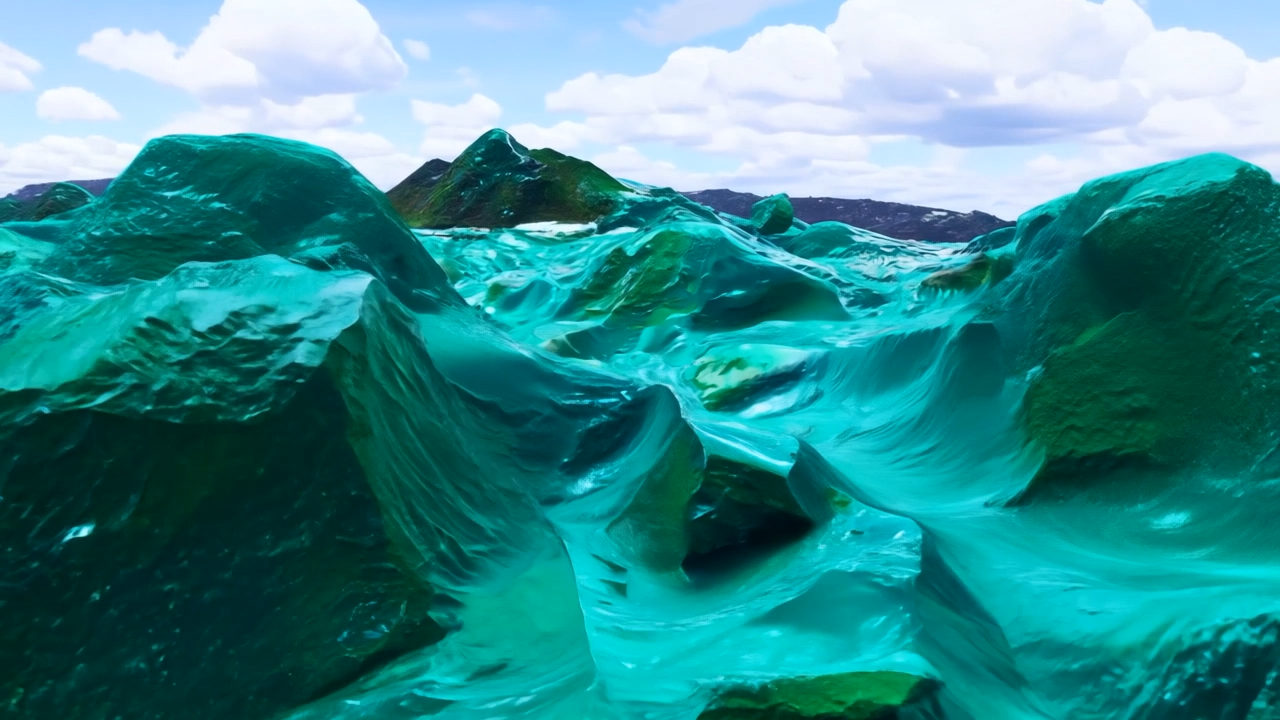
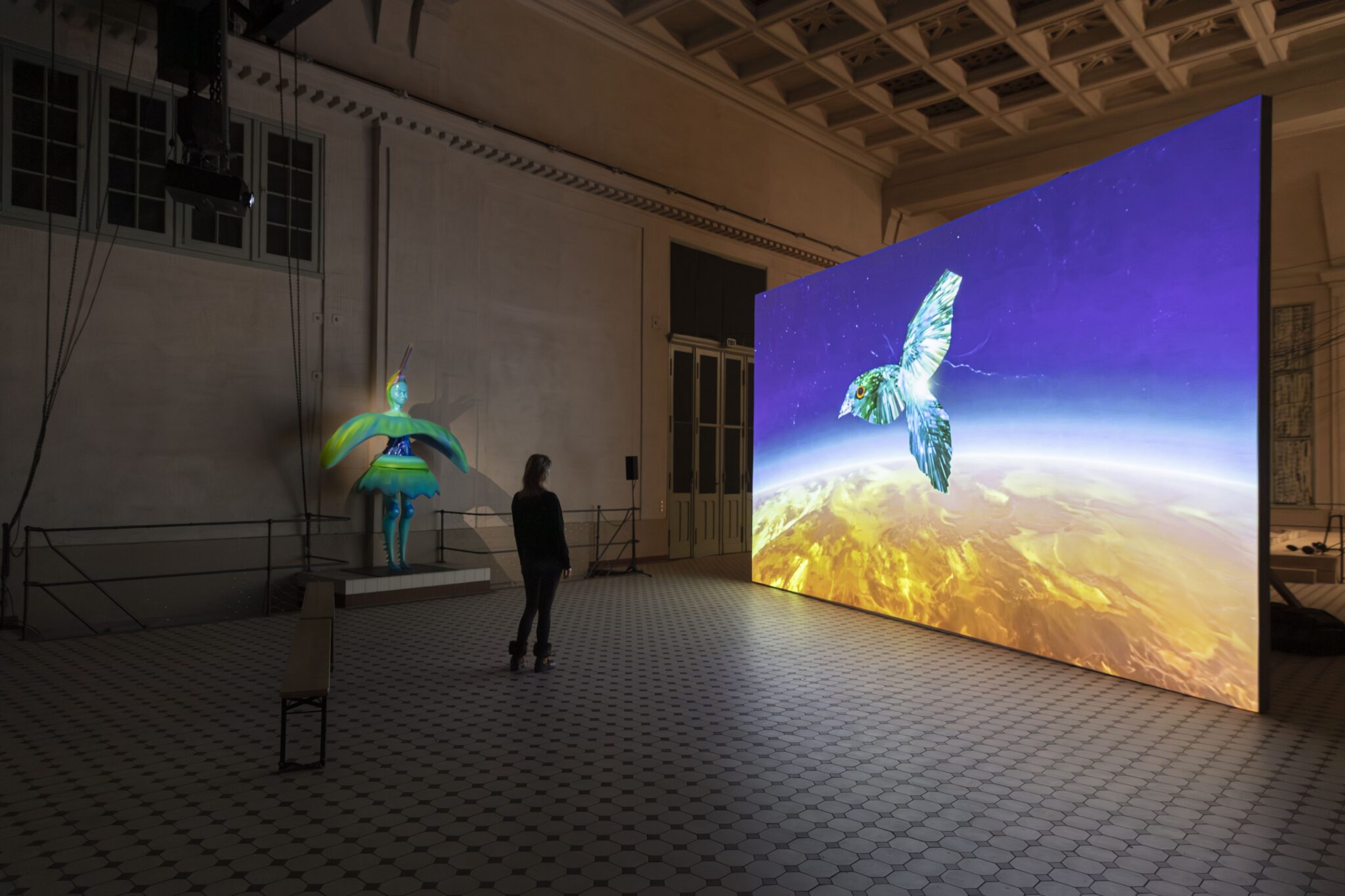
KX: Deep Time Dance (2024) is a speculative origin story for an interspecies and two-spirit future that asks what the ideal conditions are for life to emerge, for life to exist. This work is based on the Guaraní story of Tupã Tenondé, the creator of all life, and the Mainumby, the hummingbird who nourished and inspired the deity while the world was being made. It is an ode to native survivance and the deep-time geologic formation of Abya Yala. I created an evolving world-in-the-making that centers joy, pleasure, and dance.

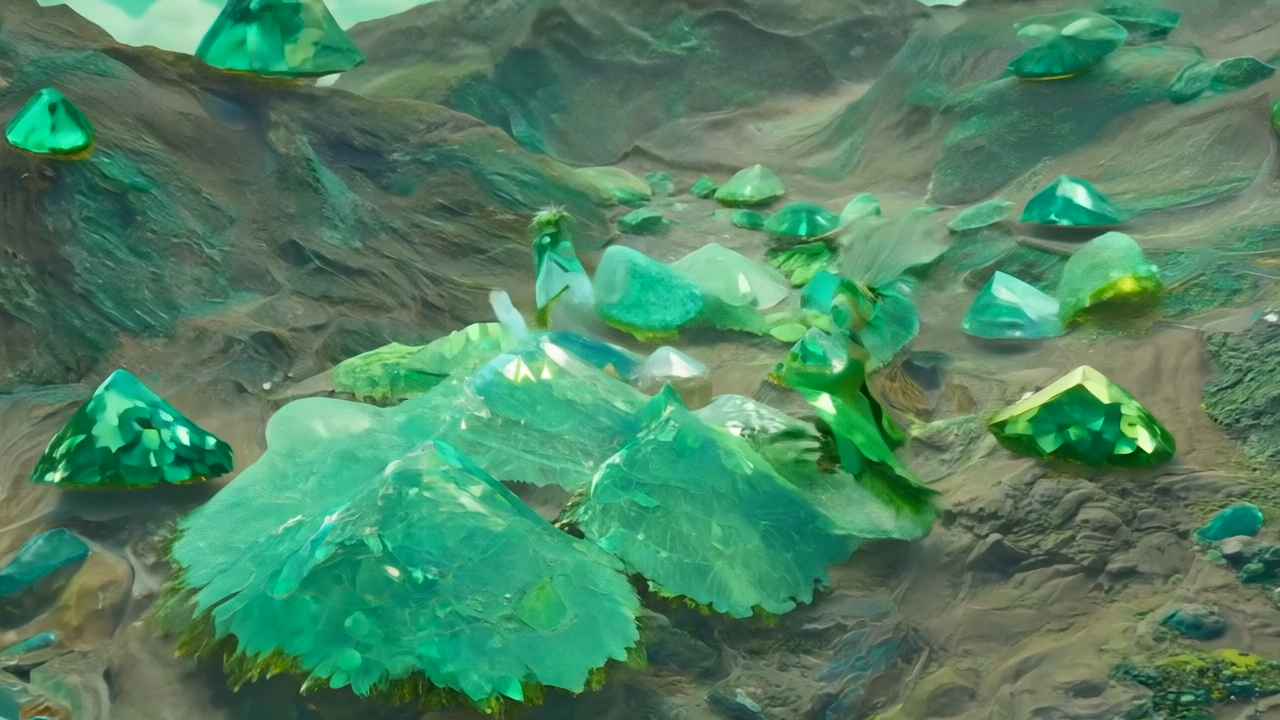
Excerpt. Kira Xonorika, Deep Time Dance, 2024. Film. 8 minutes 16 seconds, All Watched Over by Machines of Loving Grace exhibition, presented as part of PST ART: Art & Science Collide, presented by Getty, commissioned by REDCAT, Roy and Edna Disney/CalArts Theater. Further credits: Direction and models, Kira Xonorika; modeling, San Joserra; music score, Nancy Samara; editing, Sonia Wu; motion graphics, Occulted.

[Deep Time Dance] is an artwork that ties somatics with geological formations of the earth, felt in the body—a call to respond to sacred dance. A psychedelic hallucination, measured and made in a mind hallowed by choreographic methodologies like Butoh and the Indigenous dance practices of the Guaraní.

I looked into the material histories of Deep Time, the geological time frame encompassing planetary change and the development of life before the Anthropocene, before we came. Specifically, I wanted to incorporate the color green because, in Guaraní, it’s associated with the hummingbird. Hummingbirds can have a beautiful iridescence that merges metallic shades of green, emerald, deep blue, and purple, and, interestingly enough, in the [Guaraní] language, the colors green and blue are not distinguished. 

And because of my specific love for the color green, I also love the Olivine mineral, which, as a gem, forms as a peridot. [Olivine] is a mineral that makes up the majority of the Earth’s mantle, making it a transformable terrestrial mineral, but it has also been discovered in meteorites and on the moon; existing across the cosmos, it fascinates me. Its properties strongly influence the flow that drives the movement of tectonic plates, which helps shape the Earth. 

As I was working on this, I was thinking a lot about the conversations around space colonization, which uses the same playbook as the colonization of the Americas, and it’s now being applied to AI to advance colonization in space. Basically, this work is a microcosmic reflection of what happens on an intergalactic scale on a smaller scale.

The hummingbird, Ñandu Ru, appears again, but as a monument! What inspired you to reimagine them as this?

KX: In 2025, I made Mainumby. Going into this work, I thought a lot about monuments and what it means to have a monument. Monuments are often a reflection of the dominant society’s record of history. Monuments are usually devoted to heroes, and sometimes spiritual figures, especially in the US, where monumentality is equated with permanence, territory, and extractive settlement. Also, Guaraní cultures have been mischaracterized in colonial historiography as non-monumental because of their nomadic practices. I wanted to re-shift common notions of monuments into sculpture that directly challenges that logic.

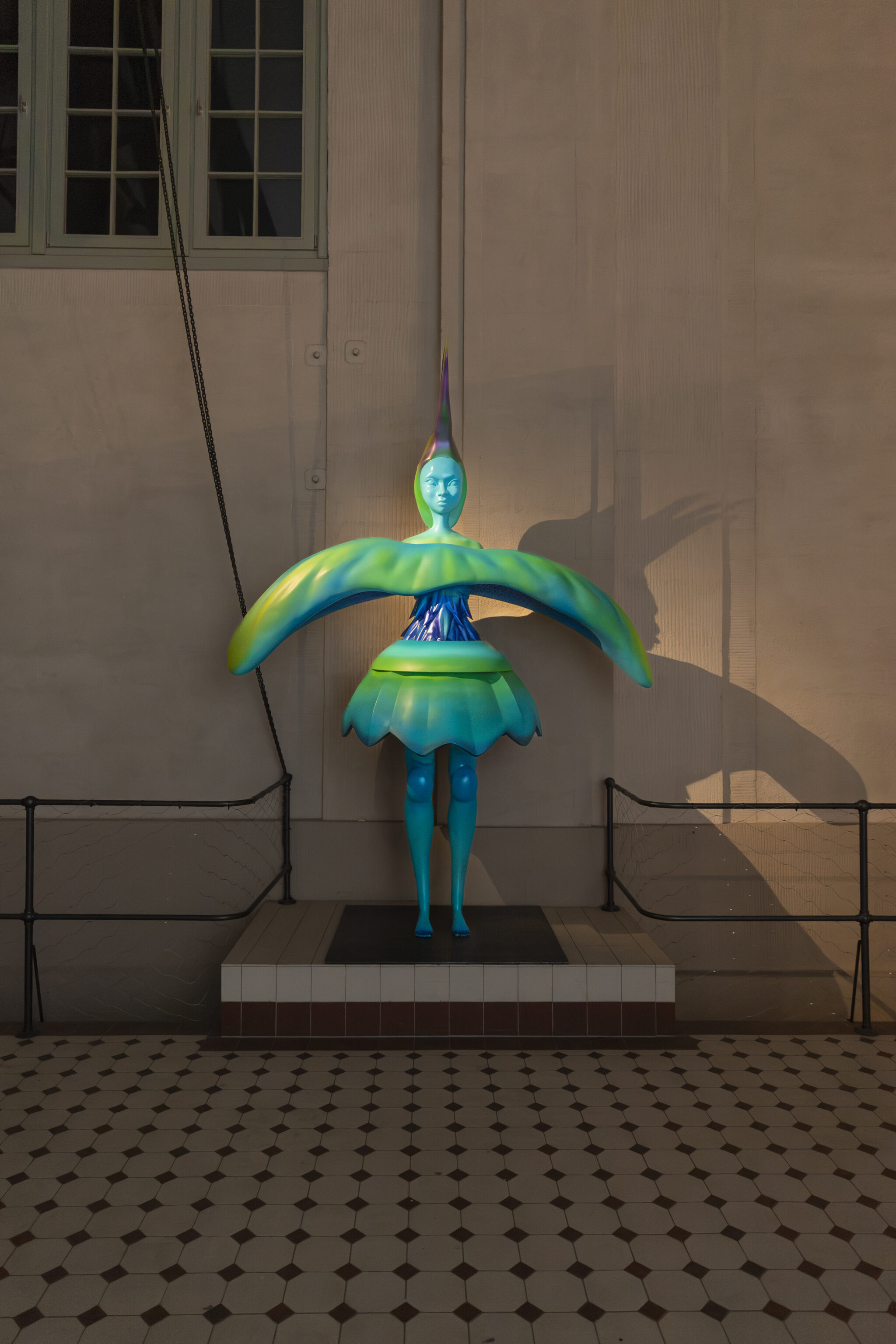
Installation view of Kira Xonorika, Mainumby, 2025, at the Mensch Maschine: Return to Earth, at the Turbine Hall in E-WERK Luckenwalde, Berlin, DE; Co-produced by JUNGE AKADEMIE akademie der Künste and E.ON Foundation. Photo credit: Laila Kaletta.

The Monument Lab, an organization based in Philadelphia that reimagines monuments as sites for healing, learning, and belonging, conducted a nationwide audit of monuments with support from the Mellon Foundation.* The statistics uncovered by this comprehensive survey really had me thinking deeply about the idea of the power to convey stories and what stories get to be visible in public spaces. 

*Note: In the report, they looked at the top 50 US public monuments, which include eleven US presidents and twelve US generals. Half of the Top 50 list (50%) enslaved other people. More than a third (40%) were born into family wealth. A large majority (76%) owned land. Only 10% of the Top 50 were Black/Indigenous, and 6% were women.

For the most part, we make monuments for shitty moments in history that celebrate wars and moments of colonial displacement, but from the perspectives of White settlers, “fifty-three massacre monuments memorialize the killing of white settlers or soldiers by Indigenous tribes, while only four represent the killing of Native populations by white settlers.”

With all of this in mind, I was inspired by the hummingbird whose image I evoked for Deep Time Dance and thought, “What would be the highest form of the hummingbird?” Growing up, I learned about the Mainumby as the manifestation of the “Great Father” associated with creation, but later I found out that this figure is actually a primordial, shape-shifting force in the form of a hummingbird, with no specific gender attached. Mainumby is not a man. Spanish colonization brought Baroque imagery to South America, and with this came the forced transfiguration of the cosmological figure, a process of assimilation that gradually folded them into the Catholic canon. From a figure of nature, they were molded in the image of the Christian God as a singular, masculine human figure, the Anthropocentric Divine.

Installation view of Kira Xonorika, ‘Mainumby’ (Left) and ‘Deep Time Dance’ (Right), 2025, at the Mensch Maschine: Return to Earth, at the Turbine Hall in E-WERK Luckenwalde, Berlin, DE; Co-produced by JUNGE AKADEMIE akademie der Künste and E.ON Foundation. Photo credit: Laila Kaletta.

The transition from devotion to nature, understanding of divinity rooted in relationality, multiplicity, and movement, to devotion to MAN is quite fascinating, very wild. I decided to intentionally Queer their form.

I used the ideas surrounding monuments and Ñande Ru’s immemorial temporality in this work to intervene in the historical rupture by reimaging them as a two-spirit entity, reclaiming gender plurality and cosmotechnical agency. The piece performs a speculative operation: it renders visible a figure that Guarani tradition has intentionally left unfigured, while refusing Western notions of representation as fixation/domination. The sculpture does not seek to “capture” Nanderú, but to activate a monument that gestures towards flight, vibration, and perpetual becoming.

What are some other ways you explore other intelligences in your work? 

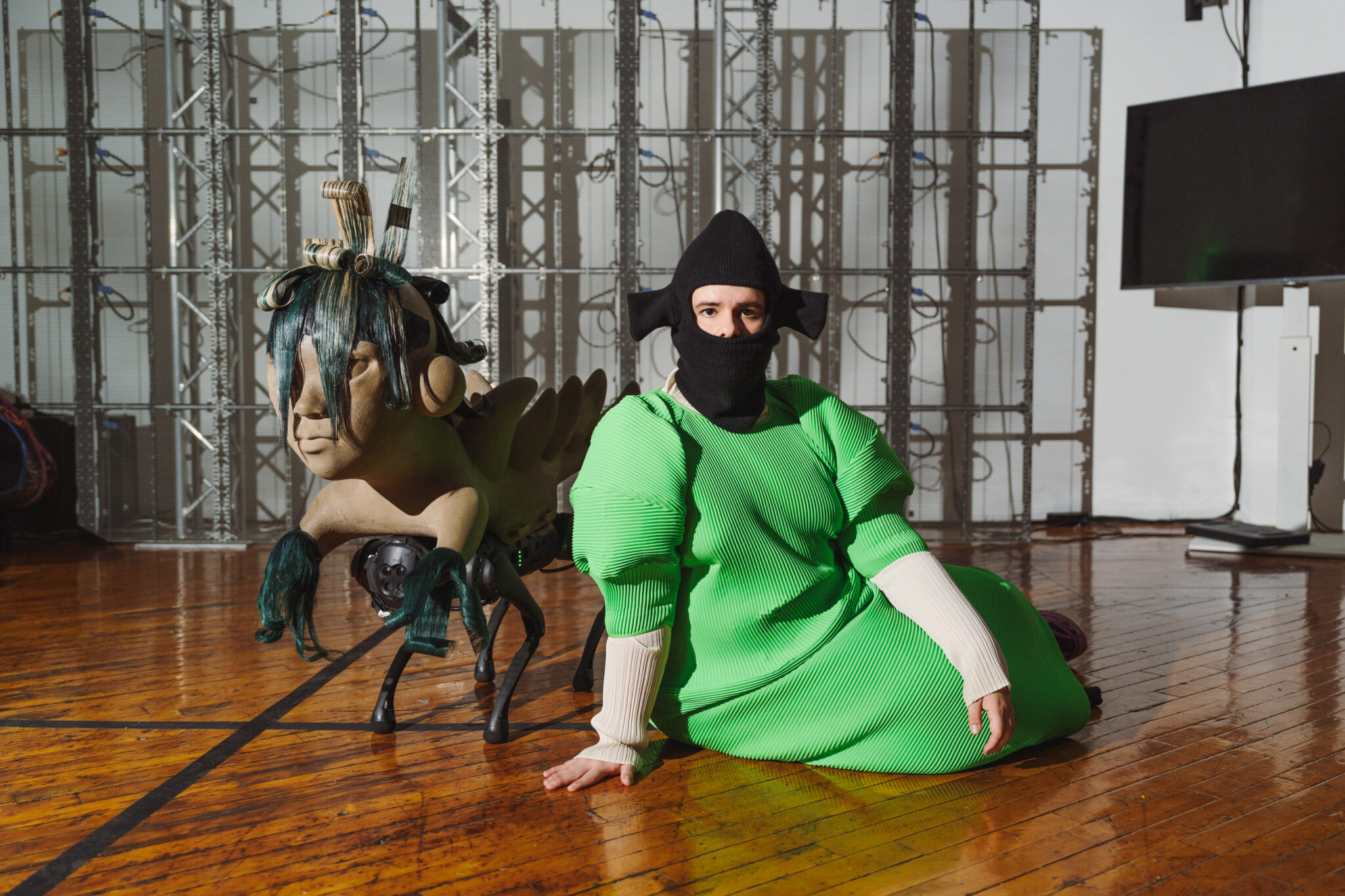
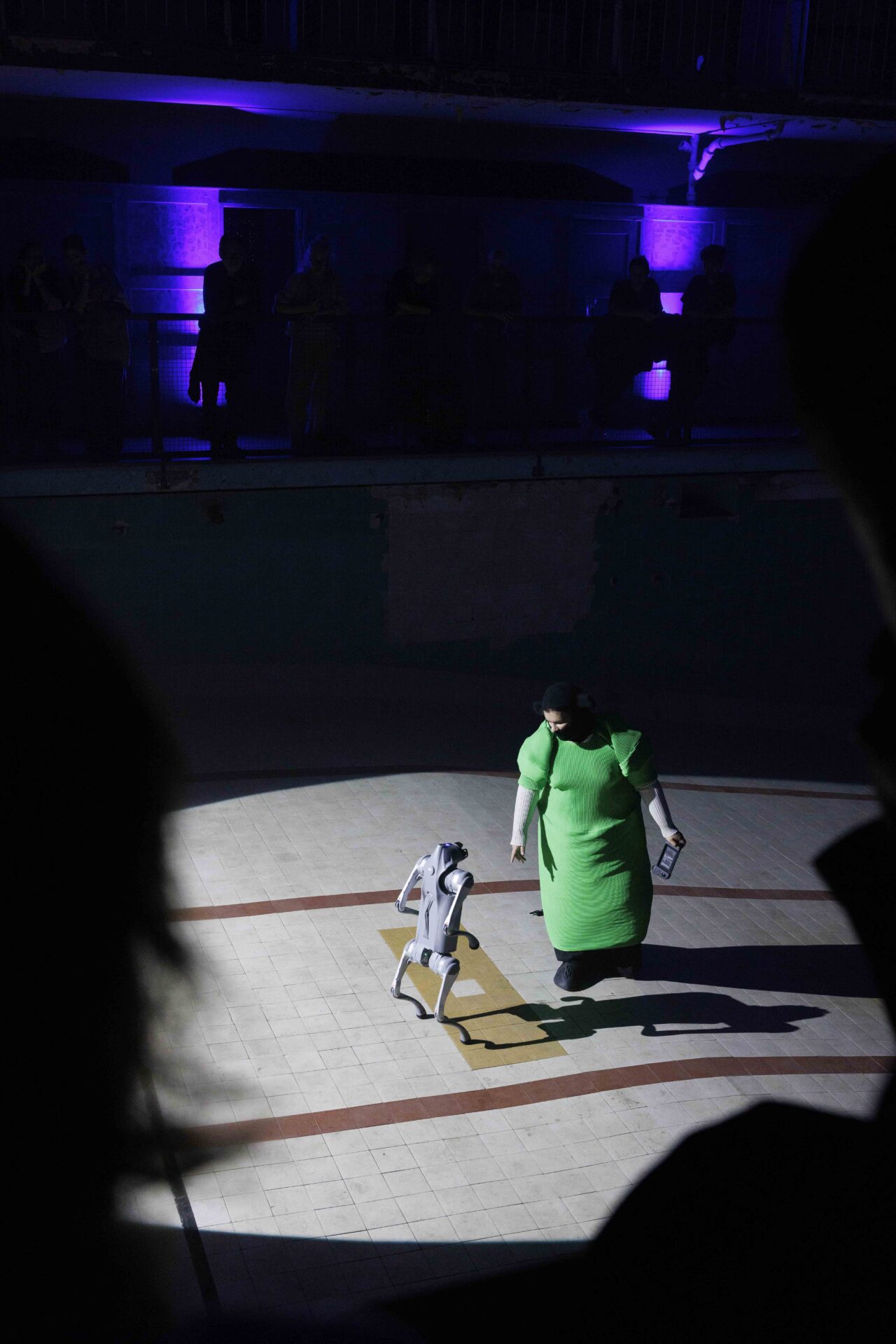
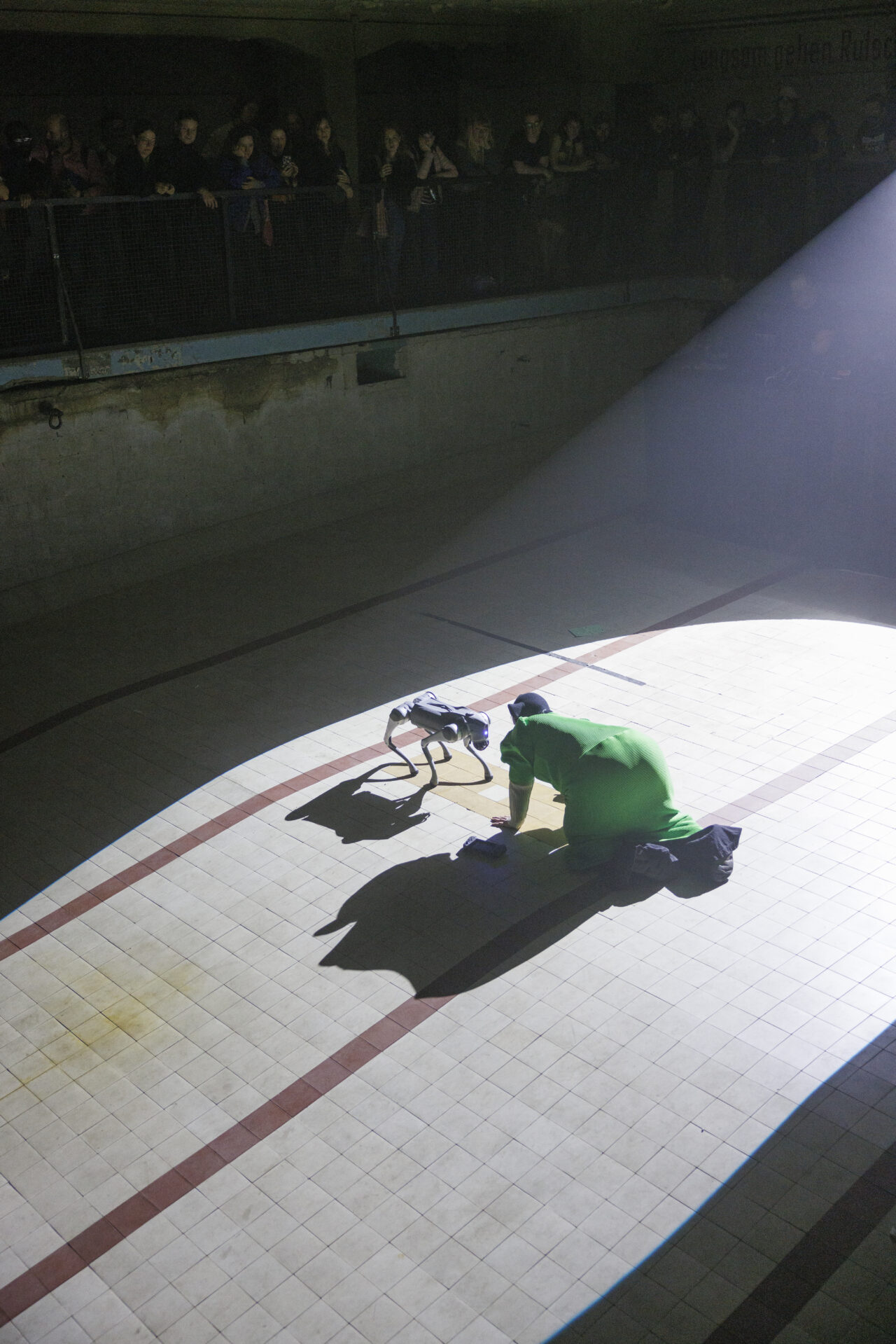
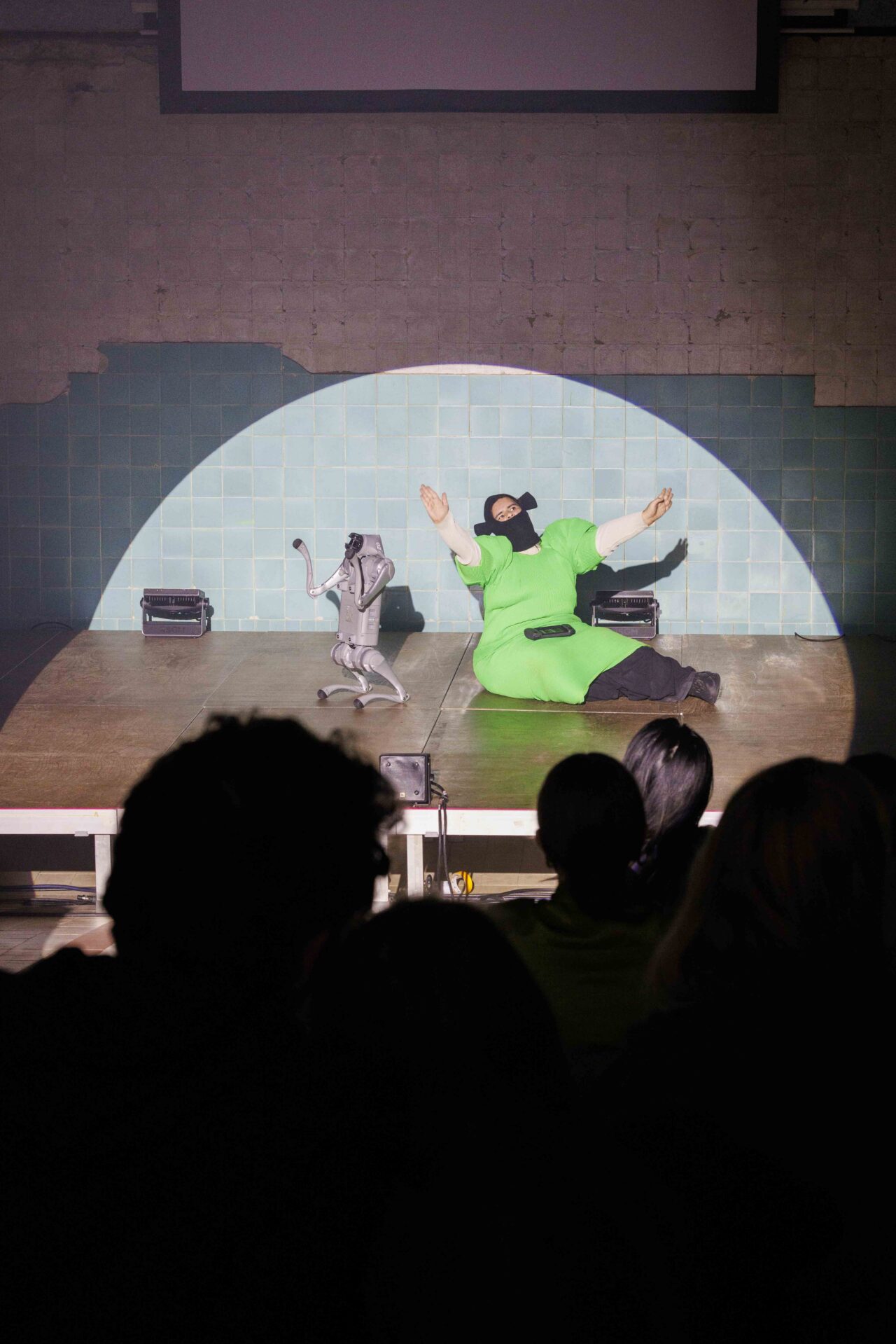
KX: Going off of my exploration of other intelligences, beyond human, I began to play around with my first experience encountering a robo-dog, Sweetie, a sophisticated soft robot. I was in a simultaneous state of fear and fascination. This performance, Agent (2025), goes back to the writing I did a few years ago for e-flux about how transness was written in media, specifically in the Latin American context. The liminal encounters of “what is normal and objective” versus what is “subjective.” I wanted to explore the initial feeling of fear when I met Sweetie, with the intention of decoupling our relationship with technology from domination.

Kira Xonorika with Sweetie, ‘Agent,’ 2025, Rip Space, Los Angeles, CA. Photo Credit: Brandon Tauszik

I began working on this project during a residency at Rip Space in Los Angeles, with the support of artist and visionary hacker john threat and curator Vera Petukhova.

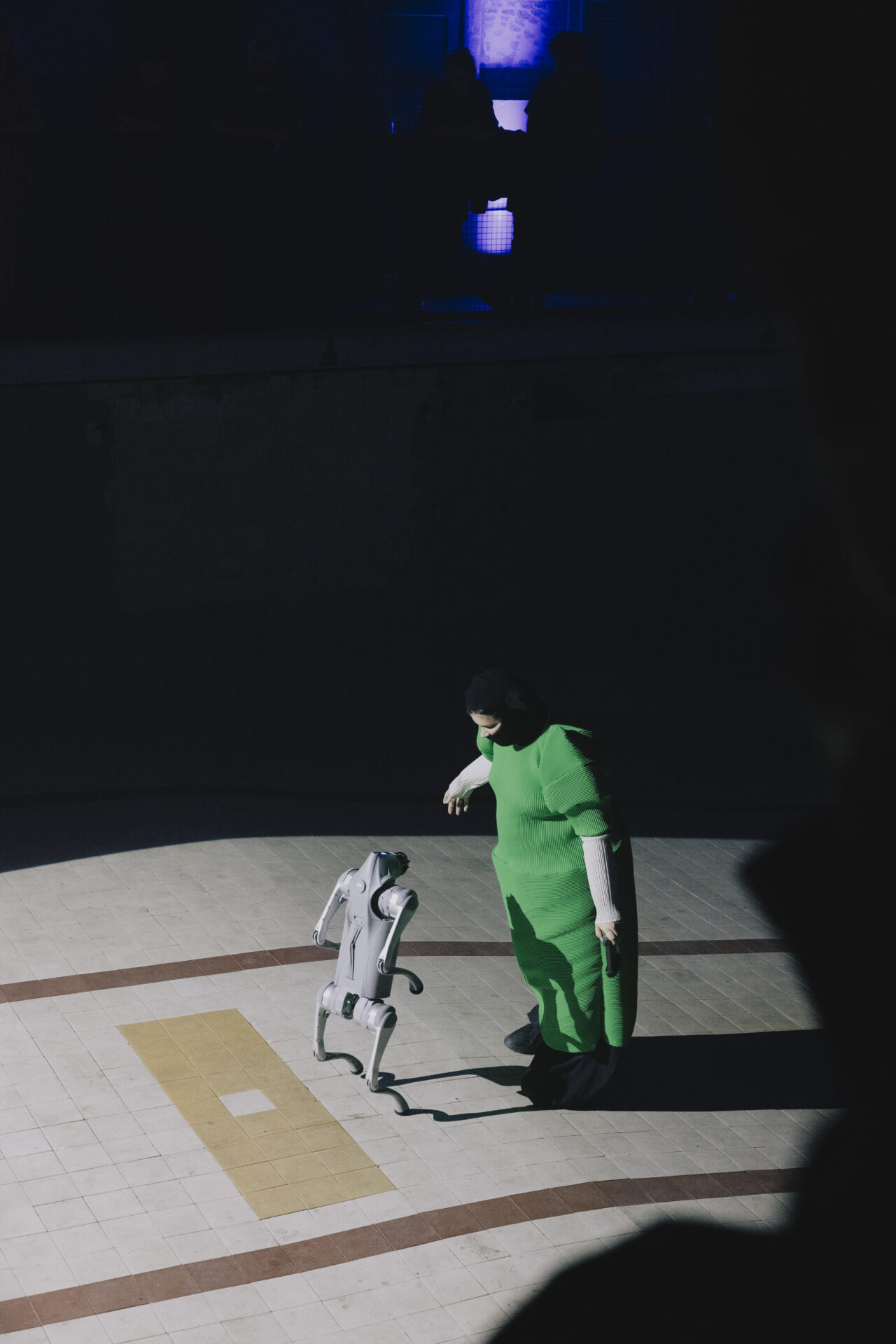
And in July of 2025, as a part of the Human-Machine Fellowship at E-WERK Luckenwalde, I had to develop this work and further opportunities to perform new iterations at the Akademie der Künste and the Bauhaus Stadtbad, with a new intelligent puppy friend, DIVA (De-militarized, Intelligent, Versatile Agent), whose exterior took on a more simplified look. 

Having performed this multiple times, with Sweetie in LA, and DIVA in Berlin, I have had a wonderful time in evolving this reciprocal dance, with hours and hours spent bonding and training with the Robo-dogs, combining responsive movement capabilities with an approachable look that challenges common perceptions people have around machines, machine embodiment, and cognition. 

Performance Shots, Kira Xonorika, Agent, 2025, Performance with an intelligent soft robot, Opening of Mensch Maschine Musik: Return to Earth, E-WERK Luckenwalde at the Bauhaus Stadtbad, Berlin, September 19, 2025, Photo credit: Kathleen Pracht. 

What does this residency allow you to do to build upon this work? How do you hope to advance this project during this residency? 

KX: One of the projects that brings me here today is “CODE FOR THE OPEN DOOR,” currently a placeholder title for a piece that was commissioned by the Humboldt Forum, which houses an ethnological museum exhibiting works of culture and art from Indigenous peoples from across the world, from Benin, Congo, China, Hawaii, New Guinea, Mesoamerica, and the Andes.

I love the modular, playful infrastructure of their tower of digital screens, which stands over twenty meters high in the foyer, thinking of it as a reassemblable vessel. I am excited to experiment with materiality, textiles, and crystals, and to explore how they would look formally on these arrays of LED screens.

But also, in thinking about the context of working with an ethnographic museum, while the conversation around repatriation is bubbling up across the world. I often think about what would be productive for me to do in this space, having been commissioned by one of the most renowned institutions, with works being called to return home. Recognizing that there are complex conditions that must be negotiated in the process of repatriation, I hope to open conversations about the speculative reframing of ethnography in institutions across the world. 

While at the residency, I hope to engage the cohort through a practice of relational ethics grounded in reciprocity, permeability, feedback loops, and radical empathy. My approach to collaboration centers accountability to difference, friction, and the uneven ways we each come to art, technology, and collective practice. A horizontal approach to collaboration, for me, means building coalitions through listening, exchange, and mutual transformation, with the understanding that plurality is not a fixed condition but an ongoing path of thinking, doing, and being.

I want to help cultivate a cohort culture where experimentation is rigorous, where people can challenge one another without collapsing difference into sameness, and where play and risk-taking are held with care. For me, the most meaningful cohorts are not the ones that produce easy consensus, but the ones that create the conditions for mutual transformation

Artist Kira Xonorika with DIVA (De-militarized, Intelligent, Versatile Agent). Photo credit: Pablo Manrique.

How do you grapple with the ideas of speculating on plurality in your practice?

KX: Speculating on plurality is less about representing multiplicity and more about activating it as a living condition. Against singular ontologies—of one timeline, one intelligence, one body—I instead propose [plurality as a] field where many worlds coexist, overlap, and negotiate meaning in real time.

Speculating on plurality also means creating a space where multilateral and polyfocal attention serves as a bridge to worlding grounded in care, reciprocity, and commonality, while remaining accountable to present conditions. I draw inspiration from Black Quantum Futurism’s work with non-linear temporalities to confront structures of confinement and reclaim access to occluded pasts and futures, raising ongoing questions about dismantling infrastructures, hacking systems, and rewiring them toward liberation. Through Indigenous Futurisms, I intervene in the present by honoring ancestral memory and cosmology, transforming continuity into resistance and a path for communal futures.

I understand intelligence as distributed rather than centralized, emerging across AI systems, ancestral knowledge, nonhuman agents, and cosmological forces. The robotic figures in my work are not symbols of a unified future but rather vessels for layered presences, where Guaraní cosmology, machine learning, and speculative spirit converge without collapsing into a single narrative. My films function as pluriversal archives in which timelines fold and coexist, undoing linear notions of history.

Eyebeam models a new approach to artist-led creation for the public good; we are a non-profit that provides significant professional support and money to exceptional artists for the realization of important ideas that wouldn’t exist otherwise. Nobody else is doing this.

Donate today